

Slime, Bone, Flesh
Practices of Knowing with More-Than-Human Bodies

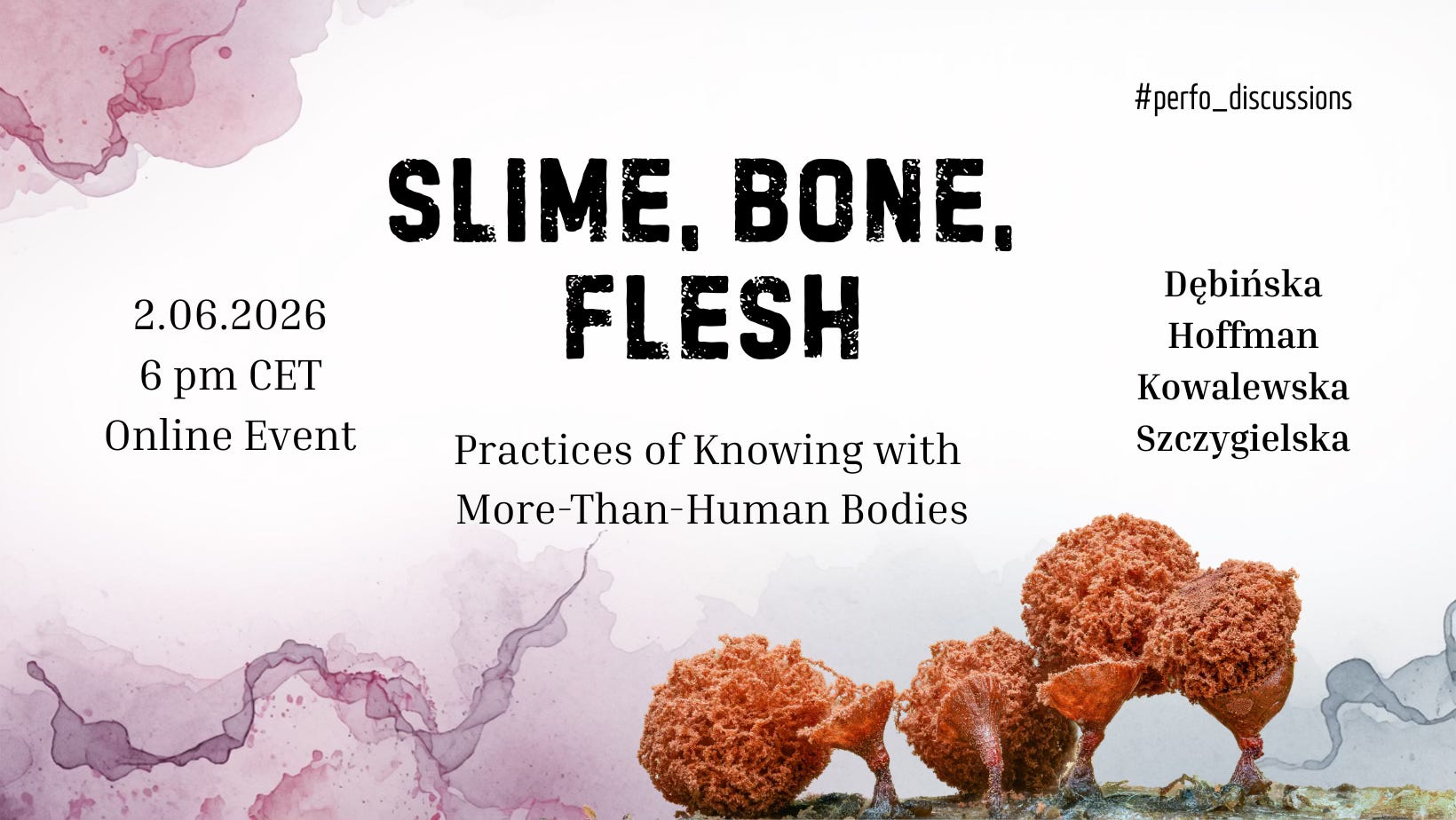
[Zoom link below]
In this edition of #perfo_discussions series, we will be exploring practices of co-creating/collecting/gleaning/constructing/fabulating/unraveling knowledges afforded when acting in cahoots with non-human bodies.
But what are the practicalities of care in such forms of knowing? What if the cahoots become extractive? What do the different parties get to learn or not learn? What is the role of distance? Can we really know with rather than about? And when does not knowing become the right choice?
With attention to bodies of (all) animals, plants, fungi, and microbes, we invite you to share in the worries, hesitations, and curiosity!
Our wonderful guests in this instalment of #perfo_discussions are:
Maria Dębińska completed her PhD in cultural anthropology at the University of Warsaw in 2015 with a dissertation on trans politics in Poland, published in 2020 under the title “Transpłciowość w Polsce. Wytwarzanie kategorii” [Transsexuality in Poland. Inventing a category] (Institute of Archaeology and Ethnology, Polish Academy of Sciences Press). Since 2019 she has been based at the Institute of Archaeology and Ethnology of the Polish Academy of Sciences, where in the years 2020-2025 she was principal investigator in the research project titled “Slime Mould as Method: An Ethnography of Scientific Practice”. Her research focuses on how scientific knowledge is adapted and reshaped in social practice.
August Hoffman is a PhD Candidate in Sociocultural Anthropology at the University of Illinois Urbana-Champaign, and an incoming Assistant Professor of Environmental Studies and Sustainability at Ramapo College. Their multispecies ethnographic work focuses on animal sanctuaries for displaced wild-type canines who are rescued from the exotic pet trade, fur farms, and roadside zoos. August’s research is especially interested in embodiment, queer phenomenology, and the relationship between care and violence.
Marianna Szczygielska is a feminist historian of science. She brings queer and decolonial approaches into reflection on human-animal relations. With a background in philosophy and gender studies, her research interests include environmental history, queer ecologies, and feminist science and technology studies. She is an associate editor of Humanimalia journal and currently works at the Max Planck institute for the History of Science in Berlin.
Moderation: Agata Kowalewska
We’re meeting on ZOOM and the discussion will be streamed live on FB
https://us06web.zoom.us/j/88182150274?pwd=5xvQIxi9BKb02eWaYsIdQsJqukCp29.1
Passcode: 562384